you may like

Tampilkan postingan dengan label lessons. Tampilkan semua postingan

Jumat, 03 Januari 2014

The "Blank Check" of Entrepreneurship

Two seconds left.  You can feel your quads burning.  Your form on the ice is rock solid.  As you race past the last defender, the only thing standing between you and the win is the goalie who you’ve beaten one-on-one countless times.  You’ve been practicing for this moment your entire life.


You accelerate towards victory, when suddenly… BOOM. An unanticipated body check, from who else, but Steve Blank. You are slammed against the wall and your entire game-plan is thrown off-course.  S.G. Blank from the opposing team has just issued his signature move, the "Blank Check" -- you know it’s going to hurt tomorrow.  Even minutes after the impact, you can still hear Blank taunting you with his infamous saying, “Get out of the building!”
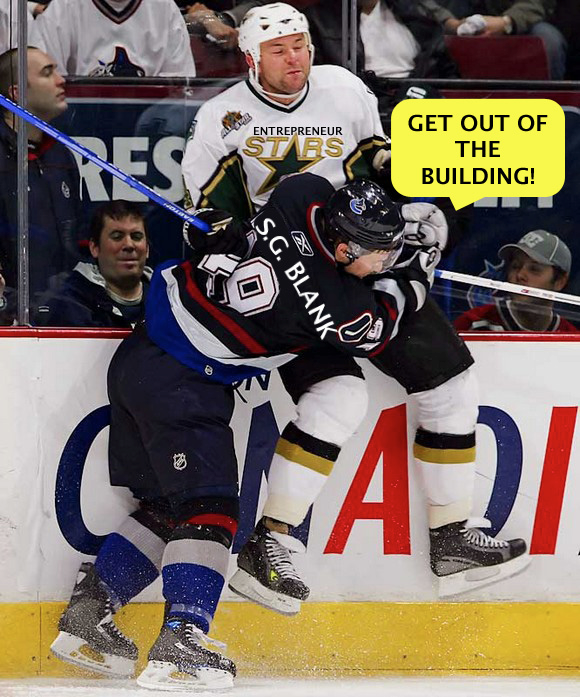
   
Getting burned on your way to victory is precisely what happens when you try to execute a business plan devised inside your company walls.  As Steve Blank would say, “No business plan ever survives first contact with the customer.” When Steve Blank, author of “The Startup Owner's Manual,” the genius behind the Customer Development process, and entrepreneurship professor at Stanford, gives you a message, he means business.  You better write this one down.

Today’s post is dedicated to his iconic message, “Get out of the building.” Your initial goal as an startup founder is not to execute a business plan.  Thinking you can build it, and then they will come, is thinking inside the building.  You have to go into the world, meet potential customers, talk to them, and learn from these interactions.  This is precisely what getting out of the building means.  You have to search for a business model.  If you plan on scoring without pivots, you are likely planning to fail.

According to Steve Blank, a startup is a temporary organization whose goal is to search for a scalable business plan.  And the magic can only happen when you go outside your comfort zone, when you talk to people.  This is exceptionally difficult for technical founders to grasp.  Dear technical masterminds with an itch for entrepreneurship: “getting out of the building” is the single most important piece of advice taken from all of Steve Blank’s writings.  Years of training, building things, and being on the forefront of technology have likely given you a skewed perspective on what the world wants.  To become a successful entrepreneur, you must first undo the damage of over-education.  Once you learn how the world thinks, your technical talent won’t go away, and you’ll be in a great position to lead a great company.

I wrote this blog post for a few reasons. Foremost, as a first-time startup founder, I've been reading endless books on the subject and writing helps me remember what I learned. I guess this blog is now about computer vision and entrepreneurship. Secondly, this post serves as a note-to-self because I've been guilty of engineering products to death and skipping customer development altogether (as you'd expect from a Robotics PhD).

To learn more about Steve Blank and his ideas on entrepreneurship, the Customer Development process, and Lean startups, take at look at the following resources:


Steve Blank
Steve Blank’s Entrepreneurship Blog (has lots of great video links)
http://steveblank.com/

Steve Blank’s Free Udacity Course “How to Build a Startup” (this was my first ever MOOC!)
https://www.udacity.com/course/ep245

Steve Blank’s book “Four Steps to the Epiphany,” which is the most influential book I read in the past 10 years.  As groundbreaking as Kuhn's “The Structure of Scientific Revolutions” was to science, Blank's "Epiphany" will likely go down in history as the one that changed the course of entrepreneurship.
http://www.amazon.com/Four-Steps-Epiphany-Steve-Blank/dp/0989200507

P.S. Another great book I just finished reading, Made to Stick, contains a similar point referred to as “The Curse of Knowledge.”  The curse of knowledge happens when your message fails to get across because you assumed everybody else is a knowledgeable as you. Or as Steve Blank would say -- you built a feature-rich product flaunting the benefits of advanced features without understanding that the world isn't filled with technical experts. Nobody cares about your features. Not yet. Get out of the building.

Sabtu, 30 November 2013

What my mother taught me about computer vision

“Wake up, Tomek.  Pack your bags.  We’re moving to America.” 

These were the words my mother whispered into my ear as she roused me from a deep sleep.  There was no alarm clock and no preparation (at least not on my behalf). I was eight years old, and it was a typical January morning in Poland.  It was 1992, and beside a brief venture into Czechoslovakia a few years earlier, I had never left Poland before.

I can still remember those words like they were uttered yesterday.  I remember both the comfort of a child being woken up by the reassuring words of one’s mother as well as the excitement of what those words meant.  It was a matter of hours until I would experience my first international flight, my first multi-lane highway, my first supermarket, and get my first dose of American television.

What I learned from my mother is that sometimes, you just have to pack your bags and go.  That is the lesson my mother taught me, and it wasn’t delivered in the form of a university lecture.  It was an action.  An action that would be the single most influential event in my life.  Moving to the Land of Opportunity from Poland wasn’t something you could not be excited about.

There is a certain kind of excitement that occurs when you make such a bold move in your life.  It requires a certain kind of courage, a certain kind of entrepreneurial spirit.  A certain vision for the future and a certain willingness to take a calculated risk.  A vision that might be filled with uncertainty, but when the uncertainty is drowned by hope, any residual fear just melts away.

My mother never taught me anything about quantum mechanics.  She never provided me with extra tutors hat would one day help me get into a good college, no guidance on how to get into a great PhD program, no etiquette lessons on how to become a respected scientist, etc.  But she gave me the courage and confidence to know that if you want something in life and you have the willingness to pursue it, you can get it. The courage that my mother's actions instilled in me have been more influential in my personal development than any single formal source of knowledge so far.  Thanks mom.

Computer vision is all about the future.  It is all about risks.  It requires a certain entrepreneurial spirit that cannot be attained within the comfy confines of the ivory tower.  I see a world where the way we interact with machines is drastically different than today.  I see a future where we are no longer slaves to our smartphones, where automation will allow us to embrace our human side.  A future where technology will allow us to be free from the worries and stresses which saturate contemporary life.  Computer vision is the interface of the future.  It will allow for both machines to make sense of the world around them, and for us to interact with these machines in a much more intuitive way.

But this sort of change cannot happen without a change in attitude.  As of December 2013, computer vision is simply too academic.  Too much mathematics simply for the sake of mathematics.  Too much emphasis on advancing the state-of-the-art by writing esoteric papers and competing on silly benchmarks.  As a community we have made tremendous advancements, but we have to take more risks.  We have to let go of our egos, and stop worrying about our individual resumes.

I no longer believe that the sort of change I want to see in the world is going to happen by itself.  I want computer vision to revolutionize the way we interact with computers.  I believe in Computer Vision the same way I believed (and still do) about America. Computer vision is the technology of the future, it is the technology of opportunity.  But this cannot happen as long as I continue to portray myself as solely an academic figure.  I know that the way I’m approaching life now is much riskier than getting a traditional job/career in the sciences.  It’s strange to admit that my last day at MIT has been much more exciting for me than my first day at MIT.  I am excited.  My fledgling team is excited.  After our product launch, we’re hoping you will participate in our excitement.  I think the fun times are only beginning. The only limits we have are the ones we impose upon ourselves. 


“Wake up computer vision.  Pack your bags.  You’re moving into everyone’s home.”