you may like

Tampilkan postingan dengan label startups. Tampilkan semua postingan

Sabtu, 07 November 2015

The Deep Learning Gold Rush of 2015

In the last few decades, we have witnessed major technological innovations such as personal computers and the internet finally reach the mainstream. And with mobile devices and social networks on the rise, we're now more connected than ever. So what's next? When is it coming? And how will it change our lives? Today I'll tell you that the next big advance is well underway and it's being fueled by a recent technique in the field of Artificial Intelligence known as Deep Learning.


The California Gold Rush of 2015 is all about Deep Learning. 
It's everywhere, you just don't know how to look.


All of today's excitement in Artificial Intelligence and Machine Learning stems from ground-breaking results in speech and visual object recognition using Deep Learning[1]. These algorithms are being applied to all sorts of data, and the learned deep neural networks outperform traditional expert systems carefully designed by scientists and engineers. End-to-end learning of deep representations from raw data is now possible due to a handful of well-performing deep learning recipes (ConvNets, Dropout, ReLUs, LSTM, DQNImageNet). But if there's one final takeaway that we can extract from decades of machine learning research, is that for many problems going deep isn't a choice, it's often a requirement.

Most of the apps and services you're already using (AirBnB, Snapchat, Twitch.tv, Uber, Yelp, LinkedIn, etc) are quite data-hungry and before you know it, they're all going to go mega-deep. So whether you need to revitalize your data science team with deep learning or you're starting an AI-from-day-one operation, it's pretty clear that everybody is rushing to get some of this Silicon Valley Gold.

From Titans to Gold Miners: Your atypical Gold Rush

Like all great gold rushes, this movement is led by new faces, which are pouring into Silicon Valley like droves. But these aren't your typical unskilled immigrants willing to pick up a hammer, nor your fresh computer science grads with some app-writing skills. The key deep learning players of today (known as the Titans of Deep Learning) are computer science professors and researchers (seldom born in the USA) leaving their academic posts and bringing their students and ideas straight into Silicon Valley.

"Turn on, Tune in, Dropout" -- Timothy Leary

Recently, Google and Facebook announced that their operations are now being powered by Deep Learning [2,3]. And with most Deep Learning Titans representing the tech giants (Yann LeCun at Facebook Research, Geoffrey Hinton at Google, Andrew Ng at Baidu), Deep Learning is likely to become one of the most sought after tech skills. With Toyota to invest in $1 Billion in Robotics and Artificial Intelligence Research (November 6, 2015), the announcement of YC Research (October 7, 2015), and the new Google Brain Residency Program "Pre-doc" AI jobs (October 26, 2015), Silicon Valley just got a whole lot more interesting.

Silicon Valley re-defines itself, yet again 

To understand why it took so long for Deep Learning to take-off, let's take a brief look at the key technologies which defined Silicon Valley over the last 50 years.  The following timeline gives an overview of where Silicon Valley has been and where it's going.


1970s: Semiconductors 
The story of the digital-era starts with semiconductors. "Silicon" in "Silicon Valley" originally referred to the silicon chip or integrated circuit innovations as well as the location (close to Stanford) of much tech-related activity. The dominant firm from that time period was Fairchild Semiconductor International and it eventually gave rise to more recognizable companies like Intel. For a more detailed discussion of this birthing era, take a look at Steve Blank's Secret History of Silicon Valley[4].
Read more about Fairchild at TechCrunch's First Trillion-Dollar Startup 

1980s: Personal Computers
Initially computers were quite large and used solely by research labs, government, and big businesses. But it was the personal computer which turned computer programming from a hobby into a vital skill. You no longer needed to be an MIT student to program on one of these badboys. While both Microsoft and Apple were founded in 1975 and 1976, respectively, they persevered due to their pioneering work in graphical user interfaces. This was the birth of the modern user-friendly Operating System. IBM approached Microsoft in 1980, regarding its upcoming personal computer, and from then on Microsoft would be King for a very long time.
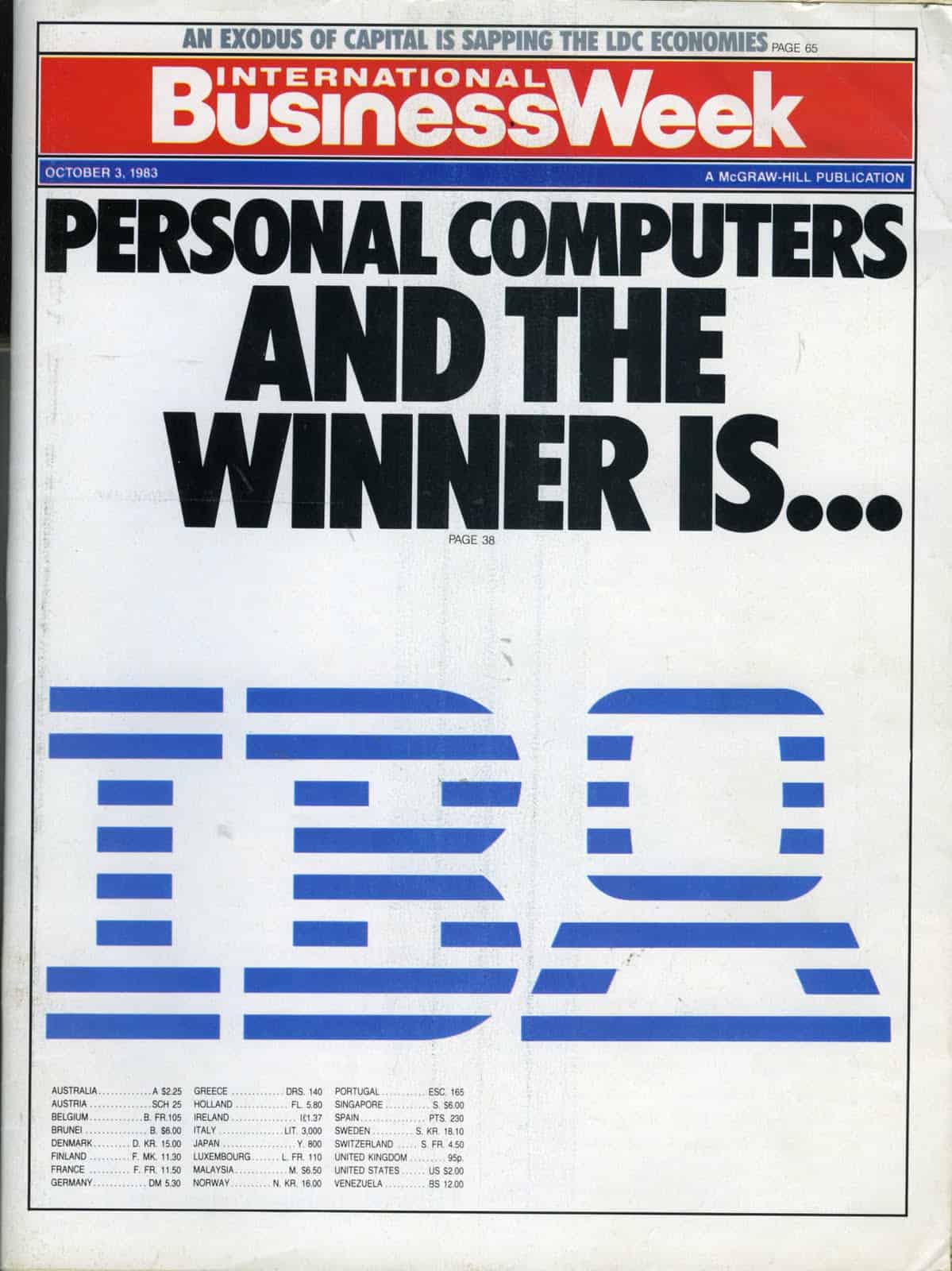
See Mac-history's article on Microsoft's relationship with Apple


1990s: Internet
While the nerds at Universities were posting ascii messages on newsgroups in the 90s, service providers in the 1990s like AOL helped make the internet accessible to everyone. Remember getting all those AOL disks in the mail? Buying a chunk of digital real state (your own domain name) became possible and anybody with a dial up connection and some primitive text/HTML skills could start posting online content. With a mission statement like "organize the world's information", it was eventually Google that got the most of out the late 90s dot-com bubble, and remains a very strong player in all things tech.

2000s: Mobile and Social
While the dot-com bubble was about creating an online presence for startups and established companies, the way we use the internet has dramatically changed since 2001. A ton of new social communities have emerged, and due to Facebook we're now stars in our own reality show. Social and advertising have essentially turned the modern internet into a mainstream TV-like experience. The internet is no longer only for the nerds. The kings of this era (Google and Facebook) are also the biggest players in the Deep Learning space, because they have the largest user bases and in-house apps which can benefit most from machine learning.

2010-2015: Deep Learning comes to the party
Spend more than a day in Silicon Valley and you'll hear the popular expression, "Software is eating the world." Rampant spreading of software was only possible once the internet (1990s) AND mobile devices (2000s) became essential parts of our lives. No longer do we physically mail floppy disks, and social media fuels any app that goes viral. What traditional software is missing (or has been missing up until now) is the ability to improve over time from everyday use. If that same software is able to connect to a large Deep Learning system and start improving, then we have a game-changer on our hands. This is already happening with online advertising, digital assistants like Siri, and smart auto-responders like Google's new email auto-reply feature.


The hierarchical award-winning "AlexNet" Deep Learning architecture 
Visualized using MIT's Toolbox for Deep Learning Neuron Visualization


Massive hiring of deep learning experts by the leading tech companies has only begun, but we also should be on the lookout for new ventures built on top of Deep Learning, not just a revitalization of last decade's successes. On this front, keep a close look at the following Deep Learning Cloud Service upstarts: Richard Socher from MetaMindMatthew Zeiler from Clarifai, and Carlos Guestrin from Dato.

2015-2020: Deep Learning Revitalizes Robotics
Recently it has been shown that Deep Learning can be used to help robots learn tasks involving movement, object manipulation, and decision making[6,7,8,9]. Before Deep Learning, lots of different pieces of robotic software and hardware would have to be developed independently and then hacked together for demo day. Today, you can use one of a handful of "Deep Learning for Robotics recipes" and start watching your robot learn the task you care about.

Robots Learns to Grasp using Deep Learning at Carnegie Mellon University. 

With their 2013 acquisition of Boston Dynamics (a hardware play), 2014 acquisition of DeepMind (a software play), and a serious autonomous car play, Google is definitely early to the Robotics party. But the noteworthy bits are happening at the intersection of deep learning and robotics.  I suggest taking a closer look at the Robotics research of Pieter Abbeel of Berkeley, Abhinav Gupta of Carnegie Mellon, and Ashutosh Saxena of Stanford -- all likely stars in the next Deep Learning for Robotics race. As long as Rodney Brooks keeps creating innovative Robotics platforms like Baxter, my expectations for Robotics are off the charts.

Conclusion

Unlike in 1849, the Deep Learning Gold Rush of 2015 is not going to bring some 300,000 gold-seekers in boats to California's mainland. This isn't a bring-your-own-hammer kind of game -- the Titans have already descended from their Ivory Towers and handed us ample mining tools. But it won't hurt to gain some experience with traditional "shallow" machine learning techniques so you can appreciate the power of Deep Learning.

I hope you enjoyed today's read and have a better sense of how Silicon Valley is undergoing a transformation. And remember, today's wave of Deep Learning upstart CEOs have PhDs, but once Deep Learning software becomes more user-friendly (TensorFlow?), maybe you won't have to wait so long to dropout.


References

[1] Krizhevsky, A., Sutskever, I. and Hinton, G. E. ImageNet Classification with Deep Convolutional Neural Networks. In NIPS 2012.
[2] D'Onfro, J. Google is 're-thinking' all of its products to include machine learning. Business Insider. October 22, 2015.
[3] D'Onfro, J. How Facebook will use artificial intelligence to organize insane amounts of data into the perfect News Feed and a personal assistant with superpowers. Business Insider. November 3, 2015.
[4] Blank, S. Secret History of Silicon Valley. 2008.
[5] Donglai Wei, Bolei Zhou, Antonio Torralba William T. Freeman. mNeuron: A Matlab Plugin to Visualize Neurons from Deep Models. 2015.
[6] Lerrel Pinto, Abhinav Gupta. Supersizing Self-supervision: Learning to Graspfrom 50K Tries and 700 Robot Hours. arXiv. 2015.
[7] Sergey Levine, Chelsea Finn, Trevor Darrell, Pieter Abbeel. End-to-End Training of Deep Visuomotor Policies. In RSS 2015.
[8] Mnih, Volodymyr, et al. "Human-level control through deep reinforcement learning." Nature 518.7540 (2015): 529-533.
[9] Ian Lenz, Ross Knepper, and Ashutosh Saxena. DeepMPC: Learning Deep Latent Features for Model Predictive Control.  In Robotics Science and Systems (RSS), 2015


Rabu, 06 Mei 2015

Dyson 360 Eye and Baidu Deep Learning at the Embedded Vision Summit in Santa Clara

Bringing Computer Vision to the Consumer

Mike Aldred
Electronics Lead, Dyson Ltd

While vision has been a research priority for decades, the results have often remained out of reach of the consumer. Huge strides have been made, but the final, and perhaps toughest, hurdle is how to integrate vision into real world products. It’s a long road from concept to finished machine, and to succeed, companies need clear objectives, a robust test plan, and the ability to adapt when those fail. 


The Dyson 360 Eye robot vacuum cleaner uses computer vision as its primary localization technology. 10 years in the making, it was taken from bleeding edge academic research to a robust, reliable and manufacturable solution by Mike Aldred and his team at Dyson. 

Mike Aldred’s keynote at next week's Embedded Vision Summit (May 12th in Santa Clara) will chart some of the high and lows of the project, the challenges of bridging between academia and business, and how to use a diverse team to take an idea from the lab into real homes.

Enabling Ubiquitous Visual Intelligence Through Deep Learning

Ren Wu 
Distinguished Scientist, Baidu Institute of Deep Learning

Deep learning techniques have been making headlines lately in computer vision research. Using techniques inspired by the human brain, deep learning employs massive replication of simple algorithms which learn to distinguish objects through training on vast numbers of examples. Neural networks trained in this way are gaining the ability to recognize objects as accurately as humans. Some experts believe that deep learning will transform the field of vision, enabling the widespread deployment of visual intelligence in many types of systems and applications. But there are many practical problems to be solved before this goal can be reached. For example, how can we create the massive sets of real-world images required to train neural networks? And given their massive computational requirements, how can we deploy neural networks into applications like mobile and wearable devices with tight cost and power consumption constraints? 


Ren Wu’s morning keynote at next week's Embedded Vision Summit (May 12th in Santa Clara) will share an insider’s perspective on these and other critical questions related to the practical use of neural networks for vision, based on the pioneering work being conducted by his team at Baidu.

Vision-as-a-Service: Democratization of Vision for Consumers and Businesses

Herman Yau
Co-founder and CEO, Tend

Hundreds of millions of video cameras are installed around the world—in businesses, homes, and public spaces—but most of them provide limited insights. Installing new, more intelligent cameras requires massive deployments with long time-to-market cycles. Computer vision enables us to extract meaning from video streams generated by existing cameras, creating value for consumers, businesses, and communities in the form of improved safety, quality, security, and health. But how can we bring computer vision to millions of deployed cameras? The answer is through “Vision-as-a-Service” (VaaS), a new business model that leverages the cloud to apply state-of-the-art computer vision techniques to video streams captured by inexpensive cameras. Centralizing vision processing in the cloud offers some compelling advantages, such as the ability to quickly deploy sophisticated new features without requiring upgrades of installed camera hardware. It also brings some tough challenges, such as scaling to bring intelligence to millions of cameras. 


Herman Yau's talk at next week's Embedded Vision Summit (May 12th in Santa Clara) will explain the architecture and business model behind VaaS, show how it is being deployed in a wide range of real-world use cases, and highlight some of the key challenges and how they can be overcome.

Embedded Vision Summit on May 12th, 2015

There will be many more great presentations at the upcoming Embedded Vision Summit.  From the range of topics, it looks like any startup with interest in computer vision will be able to benefit from attending. The entire day is filled with talks by great presenters (Gary Bradski will talk about the latest developments in OpenCV). You can see the list of speakers: Embedded Vision Summit 2015 List of speakers or the day's agenda Embedded Vision Summit 2015 Agenda.

Embedded Vision Summit 2015 Registration (249$ for the one day event + food)

Demos during lunch: The Technology Showcase at the Embedded Vision Summit will highlight demonstrations of technology for computer vision-based applications and systems from the following companies.


The vision topics covered will be: Deep Learning, CNNs, Business, Markets, Libraries, Standards, APIs, 3D Vision, and Processors. I will be there with my vision.ai team, together with some computer vision guys from KnitHealth, Inc, a new SF-based Health Vision Company. If you're interested in meeting with us, let's chat at the Vision Summit.

What kind of startups and companies should attend? Definitely robotics. Definitely vision sensors. Definitely those interested in deep learning hardware implementations. Seems like even half of the software engineers at Google could benefit from learning about their favorite deep learning algorithms being optimized for hardware. 


Kamis, 26 Maret 2015

Venture Pitch Contest at CVPR 2015 in Boston, MA

This year's CVPR will be in Boston, and as always, I expect it to be the single best venue to meet computer vision experts and see cutting edge research. I expect Google and Facebook to show off their best Deep Learning systems, NVIDIA to demo their newest GPUs, and dozens of computer vision startups to be looking for talent to grow their teams.


I expect the entrepreneur/academic ratio to be much higher, as it is getting easier for PhD students and postdocs to start their own companies.  This year's CVPR will even feature a Venture Pitch Contest as part of the Fourth Annual Vision Industry and Entrepreneur (VIEW) Workshop at CVPR. From the VIEW workshop webpage:

Computer vision as a technology is penetrating the industry at an extraordinary pace with many computer vision applications directly becoming consumer commodities. Both startups and big companies have contributed to this trend. At the fourth annual Vision Industry and Entrepreneur Workshop, we are organizing a first of its kind Startup Pitch Contest. As a computer vision innovator, this is your chance to present the next great computer vision product idea to a distinguished panel of judges which will include Venture Capitalists, Investors and leading Researchers in the field.
Applications should employ novel computer vision technologies towards an innovative product. The best submissions would be selected for an Elevator Pitch presentation in front of the judges. Prizes would be awarded to the winners who would be announced at the end of the workshop. The details about the judging criteria will be posted on the website.
The submission is broken into two phases – Preliminary submission consisting of a title and an abstract, and, Final submission consisting of a one page summary with technology overview, feasibility, outreach (customers and market size) and monetization (business model). The summary should be tailored at soliciting funding from sources such as venture capital to invest in the idea. The applicants should indicate whether they are academic researchers or industry professionals. Only non-confidential material may be submitted.

Even if you're not ready to pitch, you can submit a poster or demo to the Industry Session part of the VIEW 2015 Workshop. Great place to show off your new computer vision-powered app.  One of the organizers, Samson Timoner, told me the deadlines for submission have been extended. Here are the new dates:

Submission: April 3, 2015 (extended)
Notification: April 8, 2015 (extended)
Workshop: June 11, 2015

This year's CVPR is going to be a great place to network with startups, share ideas, see cutting-edge research and (NEW in 2015) meet folks from the venture capital world. Who knows, if I'm there, I might be wearing a vision.ai T-shirt.

Jumat, 03 Januari 2014

The "Blank Check" of Entrepreneurship

Two seconds left.  You can feel your quads burning.  Your form on the ice is rock solid.  As you race past the last defender, the only thing standing between you and the win is the goalie who you’ve beaten one-on-one countless times.  You’ve been practicing for this moment your entire life.


You accelerate towards victory, when suddenly… BOOM. An unanticipated body check, from who else, but Steve Blank. You are slammed against the wall and your entire game-plan is thrown off-course.  S.G. Blank from the opposing team has just issued his signature move, the "Blank Check" -- you know it’s going to hurt tomorrow.  Even minutes after the impact, you can still hear Blank taunting you with his infamous saying, “Get out of the building!”

   
Getting burned on your way to victory is precisely what happens when you try to execute a business plan devised inside your company walls.  As Steve Blank would say, “No business plan ever survives first contact with the customer.” When Steve Blank, author of “The Startup Owner's Manual,” the genius behind the Customer Development process, and entrepreneurship professor at Stanford, gives you a message, he means business.  You better write this one down.

Today’s post is dedicated to his iconic message, “Get out of the building.” Your initial goal as an startup founder is not to execute a business plan.  Thinking you can build it, and then they will come, is thinking inside the building.  You have to go into the world, meet potential customers, talk to them, and learn from these interactions.  This is precisely what getting out of the building means.  You have to search for a business model.  If you plan on scoring without pivots, you are likely planning to fail.

According to Steve Blank, a startup is a temporary organization whose goal is to search for a scalable business plan.  And the magic can only happen when you go outside your comfort zone, when you talk to people.  This is exceptionally difficult for technical founders to grasp.  Dear technical masterminds with an itch for entrepreneurship: “getting out of the building” is the single most important piece of advice taken from all of Steve Blank’s writings.  Years of training, building things, and being on the forefront of technology have likely given you a skewed perspective on what the world wants.  To become a successful entrepreneur, you must first undo the damage of over-education.  Once you learn how the world thinks, your technical talent won’t go away, and you’ll be in a great position to lead a great company.

I wrote this blog post for a few reasons. Foremost, as a first-time startup founder, I've been reading endless books on the subject and writing helps me remember what I learned. I guess this blog is now about computer vision and entrepreneurship. Secondly, this post serves as a note-to-self because I've been guilty of engineering products to death and skipping customer development altogether (as you'd expect from a Robotics PhD).

To learn more about Steve Blank and his ideas on entrepreneurship, the Customer Development process, and Lean startups, take at look at the following resources:


Steve Blank
Steve Blank’s Entrepreneurship Blog (has lots of great video links)
http://steveblank.com/

Steve Blank’s Free Udacity Course “How to Build a Startup” (this was my first ever MOOC!)
https://www.udacity.com/course/ep245

Steve Blank’s book “Four Steps to the Epiphany,” which is the most influential book I read in the past 10 years.  As groundbreaking as Kuhn's “The Structure of Scientific Revolutions” was to science, Blank's "Epiphany" will likely go down in history as the one that changed the course of entrepreneurship.
http://www.amazon.com/Four-Steps-Epiphany-Steve-Blank/dp/0989200507

P.S. Another great book I just finished reading, Made to Stick, contains a similar point referred to as “The Curse of Knowledge.”  The curse of knowledge happens when your message fails to get across because you assumed everybody else is a knowledgeable as you. Or as Steve Blank would say -- you built a feature-rich product flaunting the benefits of advanced features without understanding that the world isn't filled with technical experts. Nobody cares about your features. Not yet. Get out of the building.